


While only several years ago 3D printers were bulky and unwieldy freezer-sized devices and were largely the preserve of rich individuals and companies, in a last couple of years they came down in both size and price.
Suddenly, they are coming thick and fast, in all shapes and sizes, and at much more affordable prices. This sudden surge is mostly fuelled by crowd-funding and projects such as Form 1 from Formlabs, Buccaneer from Pirate3D and Deltaprintr from company of the same name (to mention but a few) all reaching their funding goals on Kickstarter. The hunger for 3D printing seems to be insatiable and thousands of DIY enthusiasts are willing to pay a reasonable price to lay their hands on their own personal fabricator.
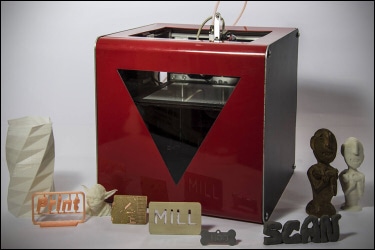
A small company FABtotum, born as a business startup at Politecnico di Milano university in Milan, Italy, tries to ride this wave of sudden interest in 3D printing and came with their own version of a personal fabricator.
FABtotum is one of the most aesthetically pleasing 3D printers on the market and this device seems to be not only good looking, but also highly functional. The creators market it as the world’s first personal fabricator, and this claim is not without merit. While other 3D printers presently on the market are just that – printers, FABtotum is the first device containing 3D scanner, 3D printer and a Mill in one compact and affordable unit.
What that means is that, in theory, you place your tea mug inside the fabricator, scan it, take it out, wait an hour or so, and hey presto: the fabricator spits out an identical twin of your treasured mug. Now you don’t have to worry about accidentally dropping it anymore (all the more that the copy is made from plastic).
In practice, however, it is not so straightforward. As the technical specifications state, FABtotum is capable of scanning solid 3D objects with its built-in laser scanner in medium quality. What it means is that to get the identical copy of your coveted mug, you would have to move the file containing the result of the scanning to your computer, load it into a respective 3D modelling editor, such as 3ds Max, refine the 3D model and then feed it back to FABtotum for printing. Still, having a 3D scanner and a 3D printer in one compact device is very practical and, don’t forget that this is just a prototype – further models would surely come with more precise scanner. On the plus side, most low-cost 3D scanners cannot acquire objects which are too small (such as a coin); FABtotum seemingly doesn’t suffer from this limitation.
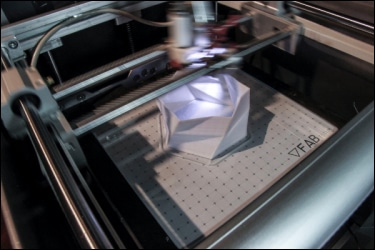
FABtotum prints objects using the FFF (Fused Filament Fabrication) technique. Printing is possible in two speeds and precisions: high speed printing for a rough prototype and slow speed printing with an improved precision for a polished model.
Compared to other low-budget 3D printers currently available, FABtotum has a very high build volume (up to 210x240x240 mm) despite its small overall size (the whole device fits into 36x36x36 cm cube – an impressive feat, considering that FABtotum is really 3 devices in one).
3D printing is not suitable for every application and this is where comes the third function of FABtotum, which we did not mention so far – milling.
In addition to 3D printer, the device features a dual-head milling machine, with an engraving/milling capabilities, which can be used on many common materials including wood, light aluminium and brass alloys.
The FABtotum is even capable of 3-axis hybrid additive/subtractive fabrication, meaning that it can work in dual mode, printing and milling in turns, without having to (re)move the printed/milled object.
At the moment, FABtotum is available in two versions: DIY kit (unassembled) which costs $999 and fully assembled version which comes at $1,099, as well as in three colours: white, black and red.
20/02/2014
