


- Developer: Ubisoft Montreal
- Publisher: Ubisoft
- Genre: Action, Adventure
- Platforms: PC, PS3/4, Xbox 360/1, Wii U
- Players: Single, Multi

Watch Dogs is a third-person, open world, action-adventure game, set in alternative Chicago, including the urban city, surrounding countryside, and even the lake Michigan, all recreated in painstaking detail.
The player assumes the role of Aiden Pearce known as The Fox, a proficient grey hat hacker and vigilante, who seeks to bring his interpretation of justice to the people responsible for the death of his niece Lena.
The city is controlled by an ever-pervasive computer system, which can be hacked into to gain various advantages. For instance, Aiden can shake off pursuers by changing traffic lights or raising road bollards, causing collisions and roadblocks. Trains can be stopped, drawbridges raised, traffic lights changed, security barriers lowered, water mains burst, and transformers exploded in order to cause blackouts – the possibilities are limitless.
The hacking is performed by the means of Aiden’s smartphone, which is equipped with multiple clever apps, namely the Profiler and the Crime Prevention System with the former allowing the player to access basic personal information on any citizen in the vicinity, while the latter notifying the player when a crime is likely to occur nearby. In the latter instance, Aiden can decide to intervene and confront the criminal.
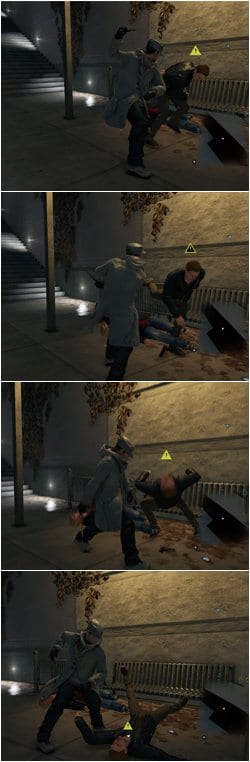
Recently, I have read a post by some particularly grumpy and irritable player, who complained that the Crime Detection notifications are disturbing him from completing the main quest. But that is completely missing the point. Watch Dogs is an open world game, which means that the player can do whatever he pleases:
If he wants, he can interrupt the main quest, try and prevent the crime, and then pick up with the main quest where he left off.
He can mark the crime spot on the map (this takes mere one quick press of the game controller, so it is hardly a major distraction – I am talking to you, Mr Grumpy), continue to the next milestone of the main quest as intended, and then return later to deal with the crime.
He can, of course, ignore the crime completely, and go on minding his own business. But why on earth would anybody in their right mind do it? Chasing the criminal through the streets, alleys and rooftops of Chicago, while negotiating pedestrians, cars and other obstacles in your way, slowly closing up on him, then finally launching yourself through the air, bringing the criminal down to the ground and beating the shit out of him with a baton, is immensely satisfying and should be prescribed as a stress relief after a bad day in the office.
Aiden may opt to shoot the escaping criminal instead (choosing from an impressive arsenal of weapons including handguns, shotguns and assault rifles), but this is unwise, as it will lower his reputation and will, more likely than not, warrant attention from bystanders, who may decide to call the police.

Aiden can also use his smartphone to hack into the mobiles of passers-by to retrieve bank account details and later steal their funds via the on-street ATMs as well as unlock new cars, which he can get delivered to a place of his choice via the Car On Demand app.
The hacking element of the game can also be used in various missions to eliminate opponents (e.g. by exploding fuse boxes), create diversions (e.g. by turning on electric appliances), or reach inaccessible places (e.g. by operating lifts and cherry-pickers).
By far the most impressive example of Aiden’s hacking skills comes when he tries to hack into ctOS (centralised operating system) servers, located within ctOS Control Centres, to gain access to all of the information and services for the particular area of the city. All the ctOS Control Centres are well guarded by heavily armed security guards. Some of the ways to get access to the server room is to sneak past the guards, knock them out one-by-one, or deal with them by force.

There is however, a much neater way to go about the business: Aiden can hack into one of the CCTV cameras close to the Control Centre, from this camera hack another one in the vicinity and in this fashion hop from the camera to camera (using the mobile cameras on the guards’ headgear when necessary) until reaching the access point to the server room. This way, Aiden can hack into the servers without a single shot being fired, or actually physically entering the Control Centre compounds.
Player can navigate his way around the city on-foot, by train, or by one of the countless vehicles which can be acquired by both legal and illegal means. In the latter instance, Aiden’s carjacking ability gradually improves, so that, for example, at the later stages a remote car lock can be hacked and car alarm disabled rather than smashing the side window as Aiden does initially.
And when the player gets bored of all this arduous server-hacking and crime-fighting, the city offers an assortment of side quests and mini games, such as playing chess or trying luck on slot machines, visiting gambling dens, taking part in various augmented reality games or even trying to solve a serial killer mystery.
Ubisoft, the game’s developer, also released a single-player DLC, consisting of three new single-player missions and a possibility to unlock new weapons, perks and bonuses.
To sum it up, although Watch Dogs ultimately doesn’t bring anything that we already haven’t seen before (save for the novel and well-thought-out hacking ability of the main protagonist), it is a solid game with a plausible storyline, sound AI, nice graphics, a large open world to explore, and, most importantly, a great playability, with only a few negligible bugs. Highly recommended.
Format reviewed: PC