

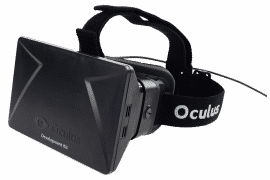


Oculus Rift – why 2014 is the year when Virtual Reality finally returs (featured preview)

Remember the 1992 science fiction film Lawnmower Man? Before your time? Touted as ‘The world’s first virtual reality movie’ the film tells a story of Jobe, a simple-minded gardener with learning disabilities, who thanks to mind-enhancing drugs and virtual reality simulations becomes a superhuman possessing paranormal abilities. The CGI scenes of the film taking place in virtual reality environment were rather impressive for an early 90s film and characters were wearing realistically-looking VR headsets and bodysuits to immerse themselves in outlandish computer-generated landscapes.
After seeing the movie, being a young and excitable lad, I had genuinely believed that in a couple of years we all will be donning similar headsets and playing awesome virtual reality games. Little I suspected that I would have to wait another 22 years before my dream becomes reality.
In the intervening years, several companies tried and failed with their attempts to come up with a fully functional, yet affordable virtual reality headset. There were a few false starts, but the headsets were bulky, resolution was low and vision was blurry. The first brave ‘test subjects’ (spare a thought for poor Jobe) of those early VR systems suffered from motion sickness and felt rather nauseous after the experience. Except for military, or special application use VR systems, costing tens of thousands or more, there was virtually nothing (no pun intended) that would bring us any closer to the virtual reality age promised in Lawnmower Man.

All has changed in September 2012, when Oculus (now Oculus VR), a small start-up from California, US, successfully raised close to $2.5 million (ten times the asking amount) on Kickstarter for the development of their virtual reality headset Oculus Rift. During the 2013, the Rift’s inventors didn’t rest on their laurels. Apart from hiring id Software’s John Carmack as their Chief Technology Officer, they managed to raise an additional $90 million and ship over 40 thousand Development Kits of their VR headset. While the Development Kit is aimed primarily at video game developers, Oculus VR is working on an improved consumer version of the Oculus Rift aimed at a general market. While not all technical specifications of the consumer version were made public as we wrote this article, we will have a close look at those features which are known or at least highly probable.
At the heart of Oculus Rift is a 7-inch LCD display with 24-bit colour depth. The display’s refresh rate is fairly high, and pixel persistence low, reducing latency and motion blur when turning one’s head quickly. Getting the latency right is one of the biggest challenges facing Oculus VR, as a big latency can not only lead to a detached gaming experience, but can also cause motion sickness and nausea. The LCD display’s resolution is expected to be 1920×1080 (High-definition) for the consumer version (as opposed to 1280×800 for the developer version).
The LCD screen displays the image twice (for the left and right eye) in an effective resolution 960×1080 per individual eye, thus creating stereoscopic (or 3D) effect. In mimicking normal human vision, the two images are not completely overlapping, with the left eye seeing some extra area to the left and the right eye seeing some extra area to the right. The image for each eye is displayed in a ‘barrel distorted’ form, that is then corrected by pincushion effect created by lenses in the headset, generating the resulting spherically-mapped image for each eye. Higher resolution of the display reduces the ‘screen door’ effect (which marred the experience a bit while wearing the developer version) and makes individual pixels less noticeable. The field of view (FOV) is 90 degrees horizontal (110 degrees diagonal), which is more than double the FOV of most other competing devices, and is the major strength of the Rift. Filling almost the entire player’s field of view, and blocking out the real world, creates a very strong sense of immersion – which is one of the prime concerns and intentions of Rift’s developers. The consumer version of the headset will likely also include Oculus VR’s new 1000 Hz Adjacent Reality Tracker with 3-axis gyro, accelerometer, and magnetometer, which makes the Rift capable of an absolute (relative to earth) head orientation tracking and, according to the developer, allows for much lower latency in tracking than most other trackers available.

The weight of the developer version is approximately 380 g, which is expected to be slightly reduced (perhaps about 350 g) for the finalised consumer version.
The video feed from the computer’s graphics card is received by the Rift via either DVI or HDMI connector on the control box and the USB port connects the motion sensors on the device to the computer to allow head tracking.
Of course, even the most sophisticated piece of hardware is utterly useless without a solid software support. This however does not seem to be a concern for Oculus VR as there is already a long, constantly growing list of more than 170 games which are either planned or confirmed for the release, and which are all compatible with the Oculus Rift.
Amongst some more obscure games are such well known titles as Castlevania: Lords of Shadow 2, Doom 3, Elite: Dangerous, Half-Life 2, Hawken and Titanfall.
And now, for the most important question: when will the consumer version of the Oculus Rift ship and how much it will cost? While Oculus VR is very coy about the exact date for the consumer version’s release, all indications point to that the Oculus Rift will start selling in the second half of the year with a price tag of $399 or less.
I had to wait 22 years for my own personal VR headset, but the long wait is now almost over. When the Oculus Rift hits the shelves, I will be the first one in the queue.
15/03/2014
