

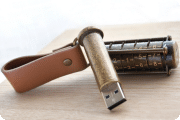


Cryptex USB Flash Drive 


While most companies making memory chips have assembly lines churning out bog-standard flash drives in their millions, concentrating on the functionality rather than aesthetics, some manufacturers are trying to come up with a design that is not only functional, but also stylish and original, or at least stands out and is pleasing to the eye.
The Da Vinci Code-themed Cryptex USB Flash Drive belongs to the latter category.
As you may recall, in the film Robert Langdon (Tom Hanks) and Sophie Neveu (Audrey Tautou) find a Cryptex, puzzle-like cylindrical container with five alphabetical rotating rings, which must be arranged in the correct sequence to spell a 5-letter code word, in order to open the container and retrieve the papyrus with the secret message hidden inside.
Cryptex USB Flash Drive is loosely based on the aforementioned container, with the difference that the letters are replaced with the digits 0-9 inscribed on the five rings. Similarly to the Cryptex from The Da Vinci Code, the individual rings on the cylinder must be lined-up to spell a 5-digit secret code, in order to unlock the mechanical lock and access the flash drive within.
The numeric code, unique to every Cryptex Flash Drive, is written on the box the flash drive comes in, and also on a small sticker on the device itself, which, after the combination is memorised, can be easily removed.
The device is made of a zinc alloy and brass-plated to give it an aged finish and steampunk-like look. The five numerical cylinders are easily rotate-able and selecting the right combination doesn’t take much longer than typing a conventional password on a keyboard, if the flash drive’s content would be encrypted and protected in this, more traditional way.
Cryptex Flash Drive ships in a simple, yet elegant, cardboard box and apart from the leather hand strap (whose functionality is questionable as it is neither detachable, nor it allows for attaching to a key-ring – a small carabiner would be more practical) comes with a small velvet pouch.

Aesthetics aside, the Cryptex Flash Drive would be pretty safe too, as there are 100,000 unique combinations that the digits 0-9 can be arranged to form a 5-digit code, required to unlock the mechanism and extract the flash drive from its casing (for comparison, your familiar debit or credit card 4-digit PIN number allows for only 10,000 possible combinations). Unfortunately, the emphasis here is on ‘would be’ as a brief examination reveals a quartet of bolts, which hold the whole contraption together, and which, when undone, make the entire casing fall apart, thus revealing the flash drive within.
With this in mind, the security aspect of the Cryptex Flash Drive can be considered nigh-on non-functional, which is a pity as the case, being made of solid metal, is otherwise pretty robust and hard to open by force, short of taking a hammer to it, and as adding an additional metal cap that would cover the heads of the bolts could easily fix this minor design flaw.
The storage capacity of the tested flash drive was 16GB, although the Cryptex USB Flash Drive will (presumably) come also in higher capacities in the future.
The data transfer speed, while not lightning-fast, is about average for a generic USB 2.0 flash drive of this capacity, with write speed 5.09 MB/s and read speed 17.76 MB/s.
At £35.00, the price is on the higher end for this capacity (today, 16GB flash drives go for less than £10), but the higher price can be justified by the complex design and metal finish of the Cryptex USB Flash Drive, which after all, aims to fulfil not only functional, but also aesthetic role.

30/03/2015